Why Buy in Rawai, Phuket: The 2026 Case for the South
Most guides to Rawai open with the sunsets at Promthep Cape. This one opens somewhere less romantic: two decisions taken in Bangkok in 2025 that changed what foreigners can actually own in Phuket. They matter more to a buyer than any beach, and they are the reason the south of the island is worth a fresh look in 2026.
Table of Contents
The two doors that closed in 2025
Foreigners cannot own land in Thailand. That has not changed. What changed is the reliability of the two workarounds that a generation of buyers relied on.
The 30+30+30 lease is no longer a promise
For years, villas in Phuket were sold to foreigners on a thirty-year registered lease with two further thirty-year renewals written into the contract. Agents called it ninety years. Buyers understood it as something close to ownership.
In decision 4655/2566, made public in March 2025, the Thai Supreme Court held that a lease cannot run beyond thirty years, and that pre-agreed renewals for further thirty-year terms are unenforceable — regardless of what the parties signed, what was paid up front, or whether the arrangement was registered at the Land Office. The Court looked at the substance of the structure rather than its form, and treated the chain of renewals as an attempt to get around the statutory limit.
The first thirty years of a properly registered lease remain valid. After that, there is no enforceable right to renew. An owner in year twenty-eight is negotiating from a weak position with whoever holds the land, at whatever price that person names.
If you already hold one of these leases, this is worth reading alongside our longer piece on leasehold versus freehold ownership in Phuket, which sets out the comparison in detail.
The Thai company route is under audit
The second workaround was to buy land through a Thai limited company in which Thai nationals held the majority of shares — usually shareholders with no real involvement, brought in to satisfy the ratio. This is a nominee arrangement, and it has always been illegal under the Foreign Business Act.
What changed in 2025 and 2026 is enforcement. Following a Cabinet review in June 2025, Thai authorities extended audits of nominee shareholding structures across the country, with the Department of Business Development, the Department of Special Investigation and the Land Department working together. Phuket, where the practice was widespread in the villa market, has been among the areas under review. Reported penalties range from forced disposal of the property to criminal prosecution.
We are deliberately not quoting the circulating figures for the number of companies investigated — we have not found them in an official source, and this is not a subject on which to repeat numbers we cannot verify. The direction of travel, however, is not in doubt.
What that leaves
One route to foreign ownership in Thailand was never a workaround, and it is untouched by either decision: the condominium.
Under section 19 of the Condominium Act, foreigners may own condominium units outright, in their own name, with the title registered at the Land Office — provided that units held by foreigners do not exceed 49% of the total saleable floor area of the building. This is freehold in the ordinary sense. You can sell it, leave it in a will, or hold it for fifty years.
The 49% ceiling has been in place for decades. Proposals to raise it to 75% in designated resort provinces, and to extend the maximum lease term to 99 years, were both announced in 2025 and both remain unenacted. Plan around the law as it stands, not as it might become; our article on whether foreigners can own condos in Thailand covers the mechanics.
So the practical question for a foreign buyer in Phuket in 2026 is narrower than it used to be: where on the island can you buy a freehold condominium, inside the foreign quota, at a price that still makes sense?
Why that question points south
Phuket’s property market has spent fifteen years concentrating on the north-west coast. Bang Tao, Laguna, Layan, Cherng Talay — the beach club strip, the branded residences, the golf. Prices there reflect it.
Rawai sits at the opposite end of the island, on the southern tip, and it developed differently. It was a fishing community before it was anything else, and it became the part of Phuket where people live rather than holiday. That distinction does more work than it sounds like.
What is actually there
Nai Harn Beach, the swimming beach for the whole southern tip, is about 4 km from the centre of Rawai. Kata is 8 km, Karon 9 km. Supermarkets are within 2.3 km. Four international schools sit within 5.7 km, which is the single most important fact about the area and the one most guides bury: schools are what turn a resort district into a place with a year-round population.
That population is why Rawai has the things a resort strip does not — a Saturday market, dentists, vets, mechanics, gyms that are open in September, restaurants that survive low season. It is also why the long-term rental market works there. A Bang Tao apartment competes for holiday lets in high season and sits empty in May. A Rawai apartment can be let by the year to a family with children at one of those schools.
What Rawai is not
Rawai Beach itself is not a swimming beach. It is shallow, and it is where the longtail boats moor — the working waterfront for trips to Coral Island and the Phi Phi group, lined with seafood restaurants. People who arrive expecting Kata are disappointed. If you want to swim, you drive ten minutes to Nai Harn.
There is no beach club scene and no nightlife to speak of. The airport is at the far north of the island, roughly an hour away, which matters if you plan to fly in and out often or to run short holiday lets. Central Festival, the island’s main shopping centre, is 13.5 km up the road.
These are not small caveats, and any agent who does not mention them is selling you something. For a buyer who wants a quiet base near good schools with a real town around it, they are irrelevant. For a buyer who wants a beachfront holiday asset with high-season turnover, Rawai is the wrong end of Phuket, and our pages on beachfront property in Phuket are the better starting point.
What it costs, from our own listings
Rather than quote market averages, here is what we actually have on our books in Phuket. Sixteen apartments and condominiums for sale outside Rawai, with the price per square metre taken from each listing:
| Area | Listings | Median price/m² | Median size |
|---|---|---|---|
| Cherng Talay | 3 | $4,689 | 42 m² |
| Laguna | 3 | $4,225 | 83 m² |
| Wichit | 4 | $3,743 | 32 m² |
| Phuket Town | 2 | $2,981 | 38 m² |
| Kathu | 3 | $2,332 | 28 m² |
Three or four listings per area is a small sample and we are not going to pretend otherwise — treat these as indicative of what we are currently selling, not as a market index. But the shape is consistent with what anyone tracking Phuket sees: the north-west beach districts price at $4,000 to $4,700 per square metre, and you come down towards $2,300 to $3,000 by moving inland to Kathu or into Phuket Town, away from any beach at all.
Rawai is the exception to that trade-off. The new-build stock currently released there runs from about $2,700 per square metre for the larger two-bedroom layouts up to $5,100 for a penthouse — which puts the entry-level end below Laguna and Cherng Talay, at an address 4 km from a swimming beach rather than 4 km inland. That is the whole argument for the south in one line.
Villas tell the same story from the other direction. The two Rawai houses we have listed work out at roughly $1,850 to $1,960 per square metre of built area — but a villa on land brings you straight back to the leasehold and company-structure problem this article opened with.
What to check before you buy in Rawai
The same checks apply anywhere in Thailand, but they are worth listing because three of them are routinely skipped.
The foreign quota. Ask for written confirmation, from the developer or the juristic person of an existing building, that the unit you are buying falls inside the 49% foreign allocation. A unit outside it can only be bought on a lease or through a Thai company, which is precisely what you are trying to avoid.
The transfer of funds. The purchase money must enter Thailand from abroad in foreign currency and be converted to baht locally. Your bank issues a Foreign Exchange Transaction form, and the Land Office will not register a foreign freehold purchase without it. Have this organised before you transfer anything.
The title and the permits. For a completed building, check the title deed and the juristic person’s accounts. For an off-plan purchase, check the construction permit and the environmental impact assessment where one is required, and read the payment schedule against construction milestones rather than dates.
The running costs. Common area fees, sinking fund, transfer fee, withholding tax on resale. Our article on the typical costs of buying property in Phuket sets out the figures.
Whether a rental programme is attached. A large share of new-build stock in Phuket is sold with a mandatory rental pool: the developer’s operator manages the unit, you take a share of the revenue, and your own use of the apartment is capped at a certain number of nights a year. There is nothing wrong with that if it is what you want. There is a great deal wrong with discovering it after signing. Ask the question in writing.
Where to start looking
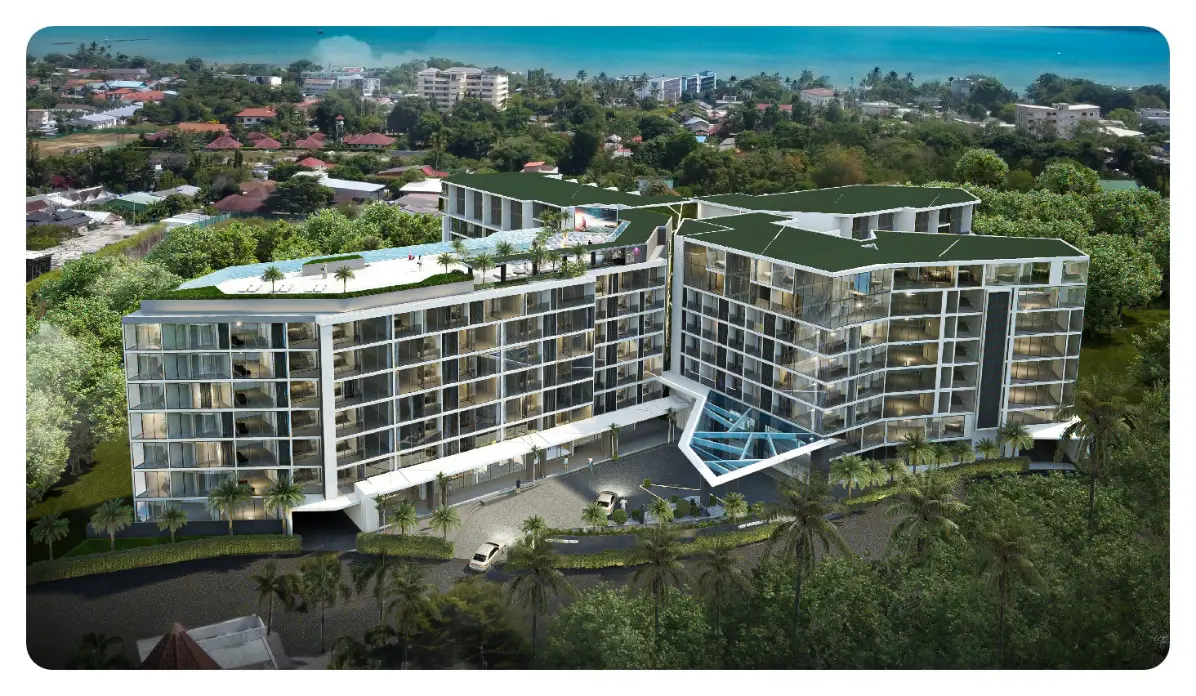
We currently list freehold apartments in Rawai at Next Point Condominium, from studios at $122,044 through one- and two-bedroom apartments, corner apartments glazed on two sides, and penthouses on the top floor. They are sold on freehold title inside the foreign quota, with no mandatory rental programme, for handover in Q4 2028.
Beyond Rawai, our Phuket apartments and condos and Phuket property pages cover the rest of the island, and the Thailand articles section has the legal and tax detail this piece only summarises.
We are not the selling agent for any development we write about, which is why these pages carry figures rather than adjectives. If you want the current availability list for anything mentioned here, ask us.
Legal position stated as at September 2026. Supreme Court decision 4655/2566 was reported in March 2025; the 49% foreign quota under the Condominium Act, the 30-year maximum registrable lease term, and the pending proposals to amend both, are as they stood at the time of writing. This article is general information, not legal advice. Take Thai legal advice before committing to a purchase.